4-6 minutes. Politics
By Kabeer Ghose
🔽 About The Author
Kabeer Ghose is a student of Political Science and International Relations who is a keen observer of contemporary politics and how it interacts and shapes identity, ideas, ideology, and culture in general.
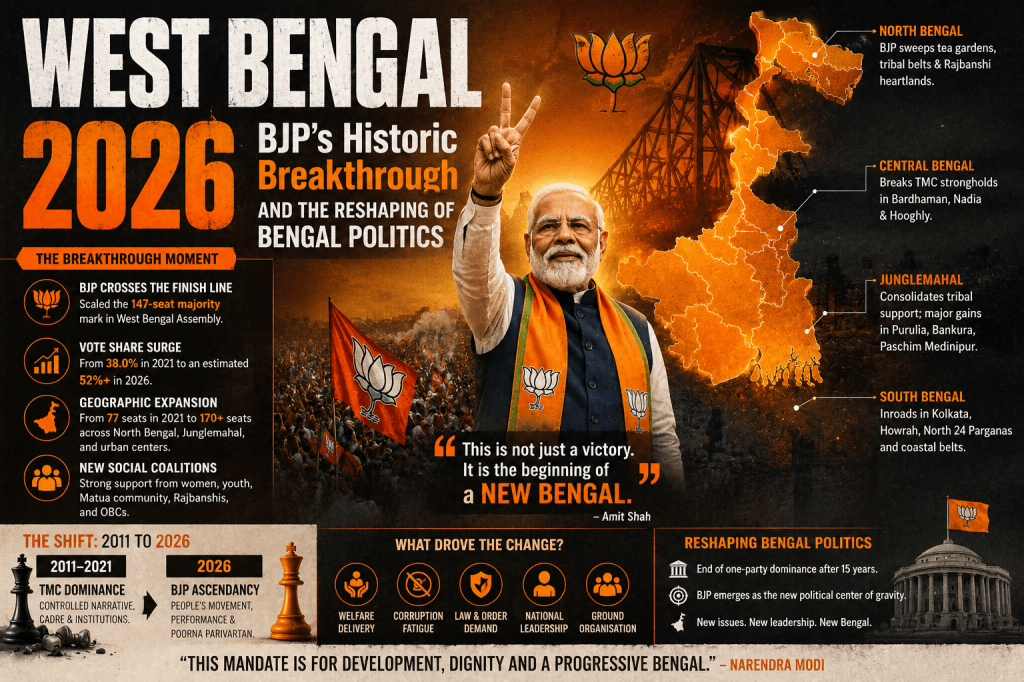
The 2026 West Bengal Assembly elections may ultimately be remembered as one of the most consequential political turning points in contemporary Indian politics. For the first time in the state’s history, the Bharatiya Janata Party secured a decisive mandate in Bengal, ending the 15 year rule of the All India Trinamool Congress (TMC) under Mamata Banerjee. The BJP’s victory was not merely an electoral upset, it represented the collapse of one political order and the emergence of another.
The verdict signals the consolidation of the BJP as a genuine pan-Indian political force capable of breaching one of the last major regional strongholds resistant to the its expansion. Bengal, historically shaped by ideological politics, left mobilisation, and later Mamata Banerjee’s populist regionalism, has now entered a new political phase defined by bipolar competition, identity mobilisation, and centralised electoral machinery.
Several factors contributed to the BJP’s breakthrough. The first was the steady organizational expansion the party has undertaken in Bengal over the past decade. From being electorally marginal until the mid- 2010s, the BJP gradually emerged as the principal opposition force by consolidating Hindu votes across caste and regional lines. The 2026 elections reflected the culmination of this long-term political groundwork.
At the same time, the elections exposed growing fatigue with the TMC’s governance model after over a decade and a half in the office. Allegations of corruption, political violence, factionalism, and administrative centralization increasingly shaped by public discourse during the campaign. Several political commentators noted that while Mamata Banerjee retained a committed welfare-support base, the BJP successfully transformed the election into a referendum on institutional decline and governance fatigue.
Economic factors also played a quitter but significant role in shaping voter sentiments. Bengal remains among the few major states still functioning under the framework of the 6thPay Commission while several others have moved to revised pay structures. This generated discontent among sections of the government employees, pensioners, and salaried middle-class voters who increasingly viewed the state as economically stagnant. Combined with concerns regarding unemployment and industrial underperformance, this weakened the TMC’s appeal among aspirational urban and semi-urban voters.
The elections were also politically contentious because they unfolded against the backdrop of debates surrounding the Special Intensive Revision (SIR) of the electoral rolls. Opposition parties and civil socity groups alleged irregularities involving large scale voter deletions under the “logical discrepancy” clause, followed by last-minute addition to the rolls through the “supplementary” voter-list carrying the names of the voters whose names were cleared by the appellate tribunals, published 24-48 hours before the respective voting days under the directions of the Supreme Court. As per reports- approximately 90.83 Lakh (9.08 million) names in total were deleted in the SIR (across various phases of the process) of West Bengal in the run-up to the elections. The process became a hugely contentious issue and became one of the most important topics of discussion amid the already fierce and hotly contested political environment.
Political analyst Yogendra Yadav argued that the results represented “the nationalisation of state politics”, where local elections increasingly mirrored broader ideological and identity-driven contests unfolding at the national level. His observation captures an important transformation in Bengal’s politics: electoral behaviour is now less shaped by older class-based or ideological alignments and more by competing narratives around nationalism, identity, welfare, and governance.
Identity politics played a central role throughout the campaign. Issues surrounding illegal migration, border security, and citizenship remained deeply embedded in political rhetoric. The BJP’s messaging resonated particularly in border districts and among sections of Hindu voters concerned about demographic change and political appeasement. Critics, however, argued that such rhetoric risked deepening communal polarization in a state historically associated with relatively syncretic traditions.
Another defining feature of the elections was the collapse of Bengal’s old political formations. The Indian National Congress and the Left Front remained electorally marginal, further entrenching Bengal’s transformation into a bipolar contest between the BJP and the TMC. This marks a striking reversal in a state once considered the intellectual and the organisational centre of Left politics in India.
The aftermath of the election also reflected the intensity of Bengal’s political polarization. Reports of post-poll clashes, political intimidation, and retaliatory violence emerged soon after the declaration of results, with the killing of a close aid to senior BJP leader Suvendu Adhikari further escalated tensions and underscored the volatile environment surrounding the transfer of power. Such tension highlighted that while the BJP achieved an electoral breakthrough, governing Bengal would present challenges different from winning it.
For the BJP, the Bengal victory carries significance beyond the state itself. It demonstrates the party’s ability to expand beyond the traditional Hindi-heartland base and establish itself across culturally distinct regions. Strategically, Bengal provides the BJP- with a stronger foothold in eastern India and deeper influence over the regional political dynamics of the northeast.
For Mamata Banerjee and the TMC, however, the verdict marks the end of a political era. Since 2011, Banerjee had positioned herself as one of the most formidable regional challengers to the BJP at the national level. The 2026 elections have substantially weakened the calm and reshaped the broader landscape of opposition politics in India.
Ultimately, the Bengal verdict reflects deeper structural shifts within Indian democracy itself: the decline of ideological politics, the rise of welfare-populist and identity-driven mobilization, and the growing centralization of political competition around national narratives. Bengal’s electoral transformation is therefore not an isolated regional story, but a part of a larger reconfiguration of India’s political order.
ENDS.
 Delhi Polity